Here’s a new section: gut.
Gut comes out of the will and the need I feel to express myself on certain subjects.
In this section I set aside all my educational, entertaining and informative clothing and become a critic.
The ripper
To open the section I’ll talk about our day to day as a graphic designer and maker: Inspiration Vs Imitation.
We’ll explore both concepts separately, analyse them together and see what their implications, motives and consequences are.
So without further delay we’ll start by looking at the idea as a whole.
It’s true that the craft of a maker is constantly evolving, and that our development doesn’t end when we leave school.
Ours is a craft of endless evolution: creators of trends or followers of fashion, depending on our creative level.
Bearing that in mind, and knowing that the best way to evolve is to stay alert to what’s being made and what’s coming, it’s easy for some graphic designers to confuse inspiration with imitation.
Because the line is very thin and it takes little to cross it.
So we understand each other, inspiration is all those works or sensations that will help us create our own designs.
Inspiration arrives unbidden, without warning, without knocking. One day you get up and find it in the kitchen in its pyjamas. You look at it and think «today definitely isn’t its best day», but you sense it has something interesting for you.
Imitation, on the other hand, is entirely predictable: it’s born of need and feeds on it, making us believe it’s perfect and needs nothing to improve.
So that combination makes us embrace it exactly as it is, with barely an objection.
It’s not the first time nor the last that I see a piece of work and think «Blimey, that’s a crude copy of…», only to read an article about it that talks of the work in terms of inspiration.
No, ladies and gentlemen, let’s not fool ourselves: inspired by is not the same as copied from.
Buying an original Versace bag is very different from buying a knock off; I’m not saying one is better or worse. But it’s true we should know what use we’ll give the object, and as customers we need to be aware of what we’re buying and what we’re spending our money on.
Once that’s clear, either option is fine.
Although professionally, as a graphic designer and photographer, the ethical and moral implications go beyond the end client.
My mind won’t let me claim as my own, and therefore present to the public, a product that’s an imitation of another.
A given design may resemble another, may be inspired by it, but the difference will always lie in knowing beforehand what you’re doing.
And to liven up the post a little, here’s a simple, clear example from a real case for you to weigh up yourselves.
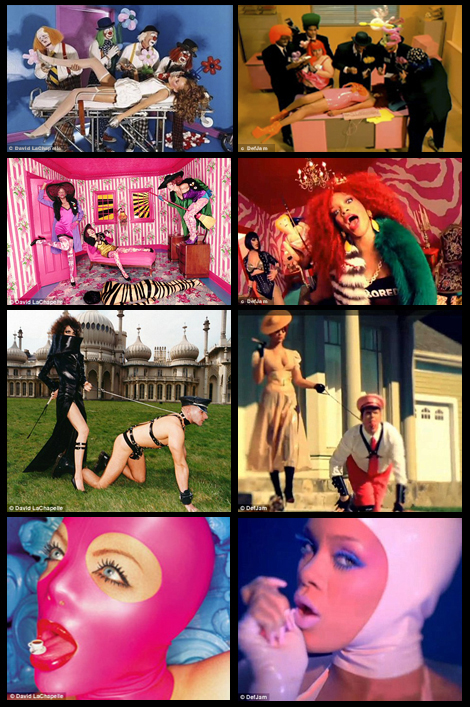
Some time ago the 22 year old singer Rihanna gave art director Melina Matsoukas a brief: to make a music video inspired by David LaChapelle.
But something went wrong along the way and inspiration turned into imitation.
David LaChapelle is a very well known photographer, above all for his bizarre images high in erotic charge and colour.
So with that brief Melina and Rihanna gave birth to the S&M video. The result was a striking piece, but with a problem imperceptible to anyone unfamiliar with David LaChapelle.
Once the video was out, the photographer sued the singer, arguing that eight of the video’s scenes were imitations of eight of his photographs.
David LaChapelle did it for no other reason than to assert the copyright in his work, but while he was at it he took her for a million dollars, which is exactly what I have in my pocket right now as I go off for a good chocolate and walnut milkshake.