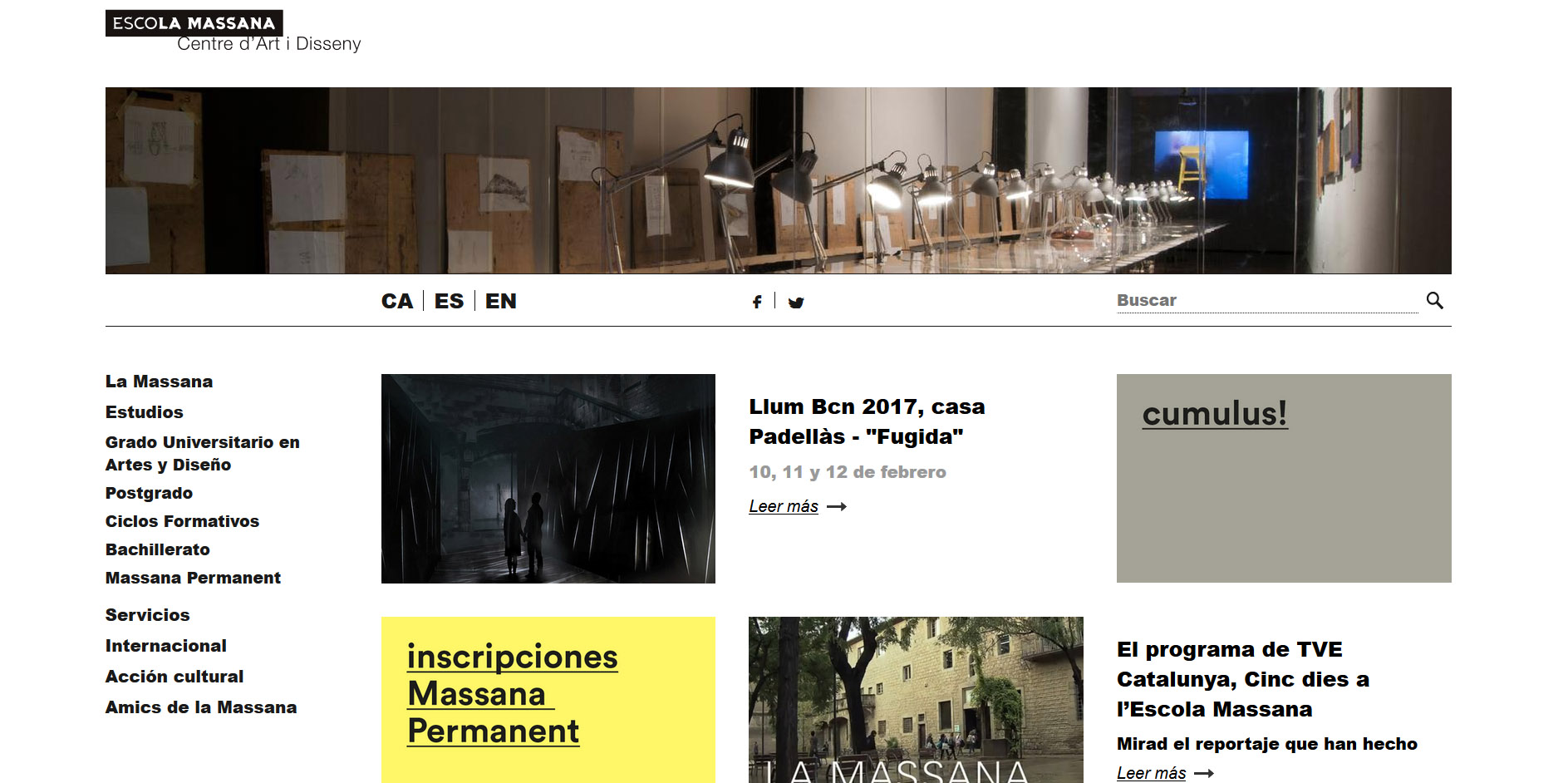
The second instalment of Create is devoted to the Massana school in Barcelona, another benchmark for graphic design in the Catalan capital.
What is Escola Massana Centre d’Art i Disseny?
It’s a municipal art and design school that grew out of the legacy of a Barcelona philanthropist, Agustí Massana, a pastry chef from the city; the school began teaching on 14 January 1929.
Its teaching philosophy is built on diversity across different study programmes, all within a single school that is a benchmark in arts and design.
Its most appealing feature, beyond a rounded education in graphic design, is the transdisciplinary conception of its Degree in Art and Design (UAB), the professionally focused offering with eight higher-level vocational courses, and the interdisciplinary nature of its arts baccalaureate.
Throughout, it places the student at the centre of learning in two directions: learning to know and learning to do, a concept I personally find very appealing.
Learning to do through hands-on experience in the school’s various workshops.
Learning to know through research, thought and critical reflection.
What does Escola Massana add?
Escola Massana has that «handmade» quality that I personally like to highlight above other things, because as well as offering a very appealing programme for graphic designers, you can learn purely craft-based creative techniques there: jewellery, working with wood and metal.
That’s a very interesting point, because it means we can learn the creative process from conception all the way through to production.
We get the chance to know what will happen to our graphic design and our creation beyond our computer screen; that will give us a lot of creative depth and let us make better use of our designs in general.
Escola Massana has a huge number of higher-level vocational courses in arts and crafts.
How do I get onto a course at Escola Massana?
Depending on which programme we want to take, we’ll need different entry requirements.
What courses does Escola Massana offer?
Escola Massana’s main axes are structured around three conceptual fields (visual arts, applied arts and design) and four curricular levels: Basic training, Higher professional training, University education and Continuing education.
The curricular level that interests us most is the University Degree in Arts and Design.
This degree brings three disciplines together in a single qualification: applied arts, visual arts and design.
This Degree in Arts and Design responds to the need for a versatile education adaptable to current demand, capable of training professionals who can work across creative processes of very different kinds.
If we decide to enrol on this degree we’ll take on making as a process directly tied to production, on top of the transdisciplinary approach the school is known for.
We’ll learn to create, to communicate and to understand complex realities as a whole.
The aim of this art and design degree is to train professionals capable of anything, from designing business cards to creating a large-scale graphic design project, from start to finish.
What will I have become when I finish the Degree in Art and Design?
We’ll be able to demonstrate that we hold, understand and connect theoretical knowledge and the historical development of art and design, its production methodology and research, through knowledge and theory of art, artistic drawing and technical drawing.
We’ll be able to apply that knowledge in any professional field related to the degree.
If we make the most of the course we’ll have become professionals from head to toe.
If what interests us
Recommended for:
Future makers
Highly adaptable people
Makers
Handy types
Designers in the making
Graphic design lovers
If this article interested you, take a look at our previous issue, Create #1, where we talked about Idep.